
What Is a Roaming Photo Booth? How It Works at Events

Most photo booths wait for guests to come to them. That works well when people are mingling and drifting around a room. It works less well at events where guests spend most of the night seated, bidding, dancing or deep in conversation, because a lot of them may not make it over to the booth at all.
A roaming photo booth solves that by reversing the setup. Instead of the guests going to the camera, the camera goes to the guests. This guide explains what a roaming booth is, how it works on the night, how it compares with a traditional stationary booth, and how to decide whether it is the right fit for your event.
What is a roaming photo booth?
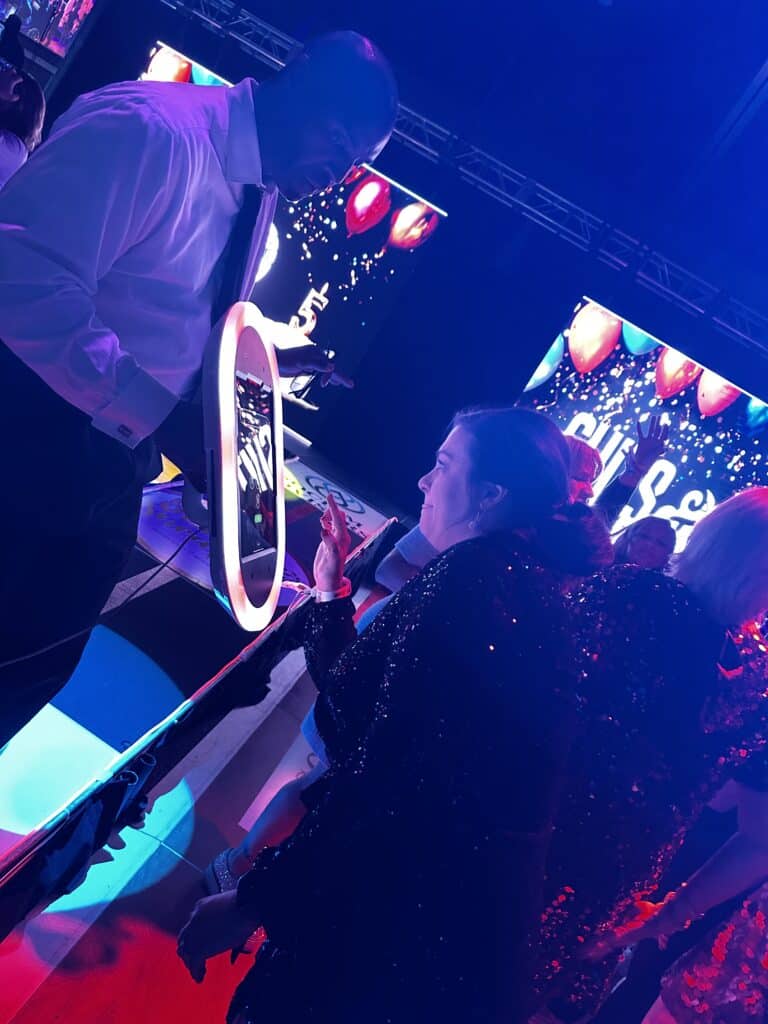
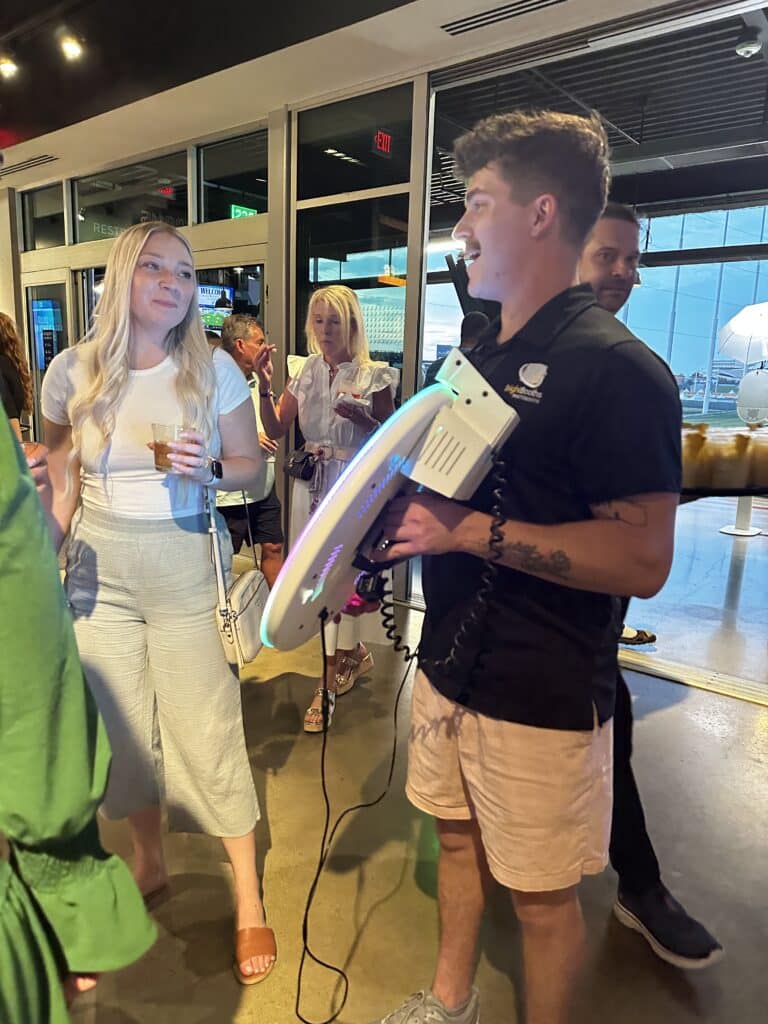
A roaming photo booth is a mobile photo and video experience run by a professional attendant who moves through your event with a handheld camera rig. Rather than sitting in one corner, the attendant visits guests where they already are: at their tables, on the dance floor, at the bar or in the middle of a crowd.
Guests still get the things people expect from a photo booth. Each photo or short video carries your event or brand design, and it lands on the guest’s phone within moments, ready to share. The difference is that guests do not have to leave what they are doing or wait in a line to take part.
Some people call this a roaming photographer with booth features, and that is a fair description. What separates it from a standard event photographer is the guest experience: branded overlays, instant delivery to each guest and content made to be posted, rather than a gallery that arrives a week later.
How a roaming photo booth works
At most events, the experience follows the same simple pattern:
- The attendant moves through the room. They approach groups, catch candid moments and set up quick posed shots wherever the energy is.
- Each session is short. A typical session takes around one to three minutes, depending on the shots and effects involved, so guests are back to their evening almost immediately.
- Every image is branded. Your logo, event name or campaign design is added as an overlay or filter, and themed props can be part of the moment.
- Guests receive their content instantly. Photos and videos are sent by text, email or QR code, so they can post them to stories or reels while the event is still going.
- You keep the full gallery. After the event, the host has a complete set of the night’s photos and videos to use in recaps, sponsor reports and future promotion.
Roaming photo booth vs a stationary photo booth
Neither format is better in every situation. They solve different problems, and many events use both.
| Roaming photo booth | Stationary photo booth | |
|---|---|---|
| Where photos happen | Anywhere in the venue | One fixed spot |
| Who takes part | Guests who might not walk over to a booth | Guests who choose to visit |
| Lines | Rarely, because the attendant goes to guests | Can form at busy moments |
| Floor space | Very little | Needs a dedicated area |
| Best moments captured | Candids, dance floor, tables, VIP interactions | Planned group shots and props |
| Typical output | Branded photos and short videos, sent instantly | Prints and digital copies, depending on the booth |
If you want a focal point people gather around, a stationary format such as a 360 video booth, a GlamBot or an enclosed booth does that job well. If you want coverage of the whole room, a roaming booth is the stronger choice.
When a roaming photo booth makes the most sense
In our experience, a roaming booth earns its place at events like these:
- Galas and fundraisers. Guests are seated for dinner, speeches and auctions, so a roaming attendant can capture them without pulling anyone away from the program.
- Corporate parties and conferences. It reaches people across networking areas, receptions and after-parties, not just the ones who find the booth.
- Product launches and retail activations. The attendant can work a store floor or a launch crowd and put branded content in front of shoppers where they already are.
- Festivals and large outdoor events. When the crowd is spread across a big area, a moving camera covers far more ground than a fixed setup.
- Venues with limited space. If there is no good spot for a booth footprint, a roaming option still gives guests the experience.
Should you pair it with a stationary booth?
Often, yes. A roaming booth and a stationary experience complement each other: the stationary booth gives guests a destination and a signature moment, while the roaming attendant covers everything that happens away from it.
At the 2025 Suits & Sneakers Gala, for example, the American Cancer Society ran a roaming booth alongside an AI trading card experience. The trading cards gave guests something to seek out, and the roamer captured the dance floor, the tables and the VIP moments a fixed booth would have missed.
How to plan a roaming photo booth for your event
A little planning makes the content far more useful afterward:
- List the moments that matter. Arrivals, the award or auction, the first dance, the sponsor wall. Share the run of show so the attendant is in the right place at the right time.
- Agree on the branding early. Decide on the overlay, logos and any campaign hashtags well before the event so the design can be built and tested.
- Think about how guests will share. Text, email and QR code delivery all work well. Ask your provider how sharing works at your venue, especially if the mobile signal is weak.
- Decide what you need afterward. If the content will go into a sponsor report or recap video, say so up front so the attendant captures the right mix of candids, branded shots and video.
- Consider pairing formats. For larger events, a roaming booth plus one stationary experience usually covers both the destination moment and the rest of the room.
Case study: the Bright Roamer at the Suits & Sneakers Gala
The 2025 Suits & Sneakers Gala at Fayetteville Town Center brought together 500 guests for the American Cancer Society’s fifth-birthday “pink tie” celebration, raising funds for cancer research and patient transportation grants in Arkansas.
The organizers needed photography that could keep up with an evening that moved from the live auction to the dance floor, without creating bottlenecks or pulling guests away from the action. The Bright Roamer met guests at their tables, on the dance floor and at the bar, and every photo carried the gala’s custom birthday branding. Guests received their photos instantly by text or email, and the organizers came away with a full gallery of the night.
Read the full Suits & Sneakers Gala case study.
Roaming photo booth FAQ
What is the difference between a roaming photo booth and a photographer? A roaming photo booth adds booth features to mobile photography: branded overlays, short sessions and instant delivery to each guest’s phone. A traditional event photographer usually delivers an edited gallery after the event.
How long does each roaming session take? Around one to three minutes, depending on the shots and effects. Guests are back to their evening almost straight away.
How do guests get their photos? By text, email or QR code, within moments of the photo being taken.
Can the photos carry our branding? Yes. Logos, custom overlays and themed props can all be built around your event or campaign.
Does a roaming booth need floor space? Very little. The attendant moves through the venue with a handheld rig, so there is no booth footprint to plan around.
Can we use a roaming booth and a stationary booth at the same event? Yes, and for larger events it is often the best combination.
Bring the booth to your guests
If your event has guests who will be seated, spread out or too busy to queue for a booth, a roaming photo booth makes sure they are still part of the content. BrightBooths runs the Bright Roamer for galas, corporate events, product launches and festivals across Arkansas, Missouri, Oklahoma and Texas.
Check your date with us and we will help you plan the moments worth capturing.