
Why the Best Corporate Holiday Gift Is the One That Comes Back Out Next December
In most companies the holiday party and the holiday gift are two separate decisions, made by two different people, out of two different budgets, usually a few weeks apart.
The party gets planned around a venue and a date. The gift gets chosen from a catalog. Neither decision has much to do with the other, and by the second week of January both have quietly stopped existing. The party is a set of photos nobody has looked at since the night they were taken. The gift is in a drawer.
That is the part worth sitting with, because both line items were real money spent with real intent behind them. Someone in that company genuinely wanted employees to feel appreciated at the end of a hard year. The intent was never the problem. The problem is that almost everything we hand people at the holidays has a short natural life, and nobody plans for what happens after it.
Ask yourself what you still have
Think about the branded items you have been given at work over the last few years. The bottles, the notebooks, the fleeces, the desk objects. Some of them were genuinely nice. Most of them are gone.
They did not fail because they were cheap. Plenty of expensive gifts disappear just as fast. They went because they were competing for space in a home against things the recipient chose for themselves, and in that competition a branded object almost always loses. The item carries the company’s meaning, not the employee’s. A logo is a reminder of where someone works, which is a fact they already have available to them every day.
The keepsakes that survive tend to have something else going for them. They carry the recipient rather than the giver. The person is in the object somewhere, either literally or through the fact that they made it, and that changes what it is. It stops being a corporate item that happens to be in their house and becomes their item that happens to have come from work.
We have written before about why this holds true for trade show giveaways and for wedding collectibles. The holidays add a factor neither of those has.
The holidays come with a calendar
Almost every keepsake depends on a person choosing to look at it. A magnet on a fridge works because it is in the way. A print works if it gets framed. Most things get one honest look and then fade into the background of a room.
A holiday ornament works differently, and the difference is structural rather than sentimental. It goes into a box in January. It comes out of that box next December, along with everything else the household has collected over the years, and it gets handled and hung and usually talked about. That happens without anybody deciding to remember it. The calendar does the work.
This is the piece most companies miss when they compare holiday gift options on price. An ornament created at your December event is not a one-day item with a one-day return. It is an item that reappears in an employee’s home every year, in a context that has nothing to do with work and everything to do with the people they care about. There is very little a marketing or HR budget can buy that behaves that way.
It also means the effect compounds. A company that does this three years running is not giving three gifts. It is building a small run of objects that come out of the same box together, and that turns into something the household recognizes as a tradition rather than a series of unrelated favors.
Why it has to be made, not handed out
There is a version of this idea that does not work, and it is worth naming so nobody spends money on it.
Ordering five hundred ornaments with a company logo printed on them and putting one at each place setting will not produce any of the above. That is swag with a seasonal shape. It has the same problem as the fleece and the notebook, which is that the object belongs to the company and the recipient had no part in it.
What changes the outcome is participation. When a guest steps into the experience at the event, has their photo taken, sees it placed into the ornament and walks away holding something that did not exist ten minutes earlier, the object has a story attached to it before they get to the parking lot. They were there. They made it. The thing in their hand is a record of an evening they were part of rather than an item that was distributed to them.
This is the thinking behind the Holiday Bauble in our 2026 Holiday Experience Collection. Guests create a personalized ornament featuring their own image, on site, as part of the event. It is the simplest concept in the collection and it is the one that stays in people’s homes the longest.
Branding restraint is the counterintuitive part
The question we get asked immediately is how big the logo can be.
The honest answer is that the logo should be small and it should be somewhere other than the front. Not because branding does not matter, but because branding is exactly what determines whether the ornament gets hung or quietly retired after the first year.
An ornament with a family’s faces on the front and a small company mark on the back goes on the tree, and it goes on the tree next year too, and every time it does the company is present in that moment. An ornament that is mostly a logo becomes a decision the employee has to make in front of their family about whether to put their employer’s advertising on their Christmas tree. Most people decide no.
Restraint is the strategy here, not modesty. The company gets a decade of recall by taking up ten percent of the object instead of ninety.
Where it fits in a wider event
None of this means an ornament is the only thing an event should offer, and for many of the companies we work with it is not.
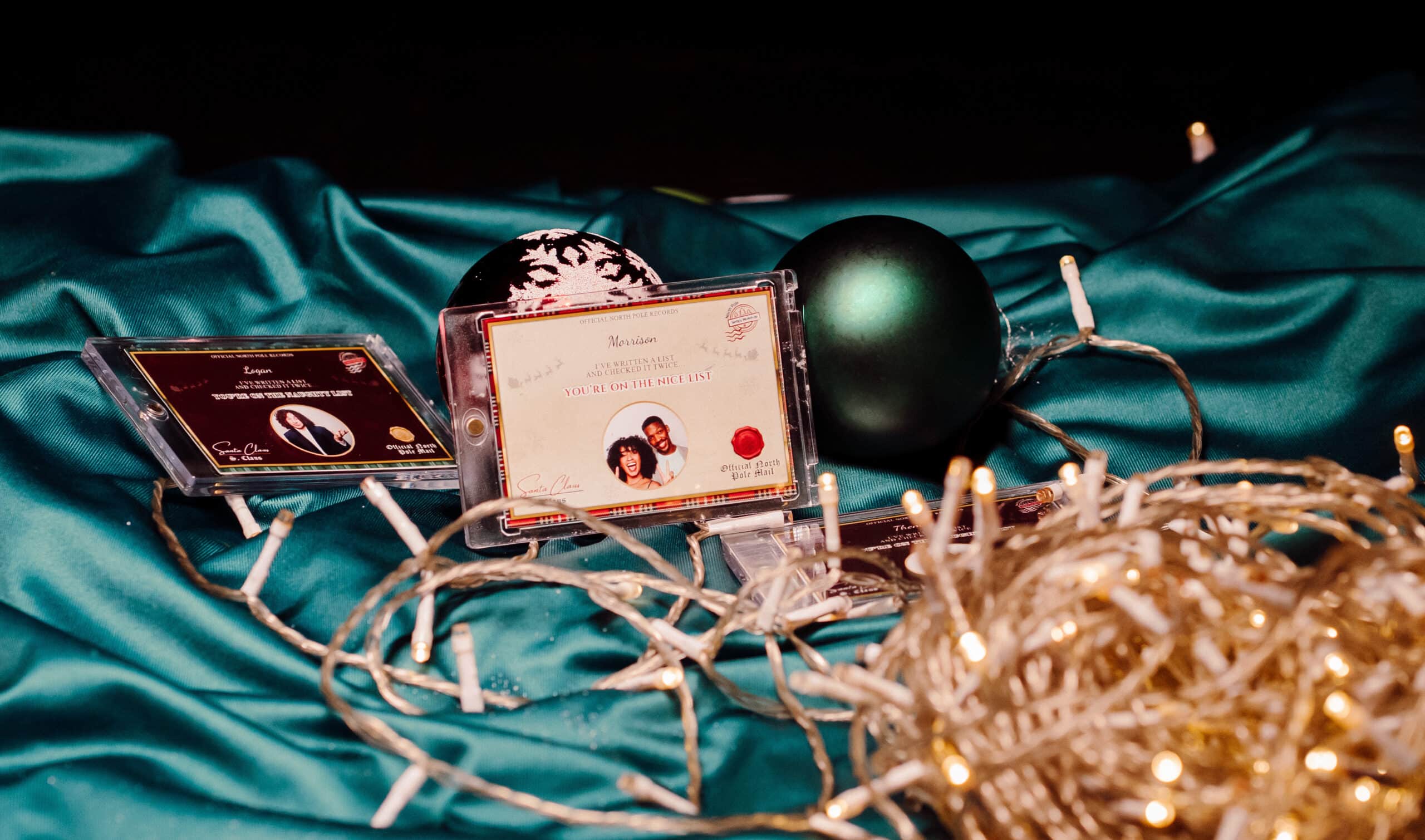
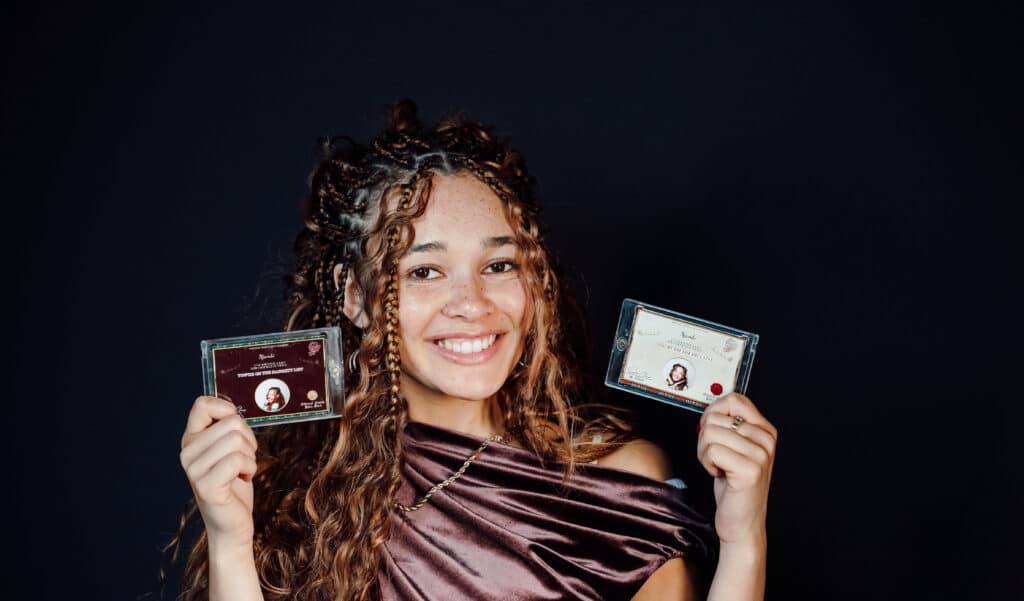
Different experiences do different jobs on the night. The Naughty & Nice Card, which turns guests into their own collectible trading card with custom holiday ratings, is the one that produces noise and comparison in the room while the event is happening. People swap them, rank each other and photograph them. That is energy during the party.
The Holiday Bauble is the opposite. It is quiet in the room and loud a year later.
A well-designed event usually wants both, one experience that creates the atmosphere on the night and one that leaves the building in someone’s coat pocket and keeps working. What matters is deciding which job you are buying rather than assuming any photo experience does both.
The budget argument
There is a practical case here that has nothing to do with sentiment.
If the gift budget and the entertainment budget are separate lines, and the entertainment line already produces a personalized keepsake that guests take home, then the two lines are paying for overlapping outcomes. Several companies across Arkansas and North Texas have started treating them as one decision instead, which usually means the event gets a better experience and the gift gets more thought, for a combined spend that is easier to justify than two half measures.
It also solves a problem that gets less attention than it should, which is that generic gifts have to be chosen for the average employee and end up suiting nobody in particular. An experience that each guest personalizes for themselves removes that problem entirely. Nobody has to guess what four hundred different people would like.
What to decide before the event
A few things are worth settling in advance rather than on the night.
Decide where the branding goes, and keep it modest. Decide whether guests receive a digital version alongside the physical one, since the digital file is what gets shared and the physical object is what gets kept, and there is no reason to choose between them. Think about packaging, because an ornament that travels home in a hand rather than a box has a poor survival rate at the end of a party. And plan the placement so the experience is somewhere guests pass naturally rather than tucked into a corner that only the confident ones find.
None of this is complicated. It is the difference between an idea that works and the same idea executed carelessly.
The short version
Most holiday spending buys attention for one evening. That is a legitimate thing to buy, and a good party is worth paying for.
But the companies getting the most out of the season have noticed that one small part of the budget can buy something that returns every December without any further effort or spend, in the homes of the people they were trying to thank in the first place. That is an unusual return for a line item, and it is available to any company already planning an event.
Planning a holiday event in Arkansas or North Texas?
BrightBooths designs holiday experiences for corporate parties, employee appreciation events, hotels and brand activations across Arkansas and North Texas.
Frequently asked questions
Can the ornaments be branded with our company logo? Yes. We recommend keeping company branding small and placing it on the reverse so the guest’s image stays the focus, which is what makes the ornament something people keep and display.
How long does each guest take? The experience is designed to move quickly so it works with a full room rather than creating a queue that pulls people away from the rest of the event.
Do guests get a digital copy as well? Digital versions can be delivered alongside the physical ornament, which is usually what gets shared online while the ornament itself goes home.
What guest numbers does this suit? It works across a wide range of event sizes, from smaller team celebrations to large corporate parties and hospitality activations. Guest count mainly affects staffing and the length of time the experience runs.
Can this replace our employee gift? Many companies use it that way, since every guest leaves with a personalized item they created themselves rather than a generic gift chosen on their behalf.
When should we book? December dates are usually committed well in advance, so the earlier a date is confirmed the more flexibility there is on the experience and setup.